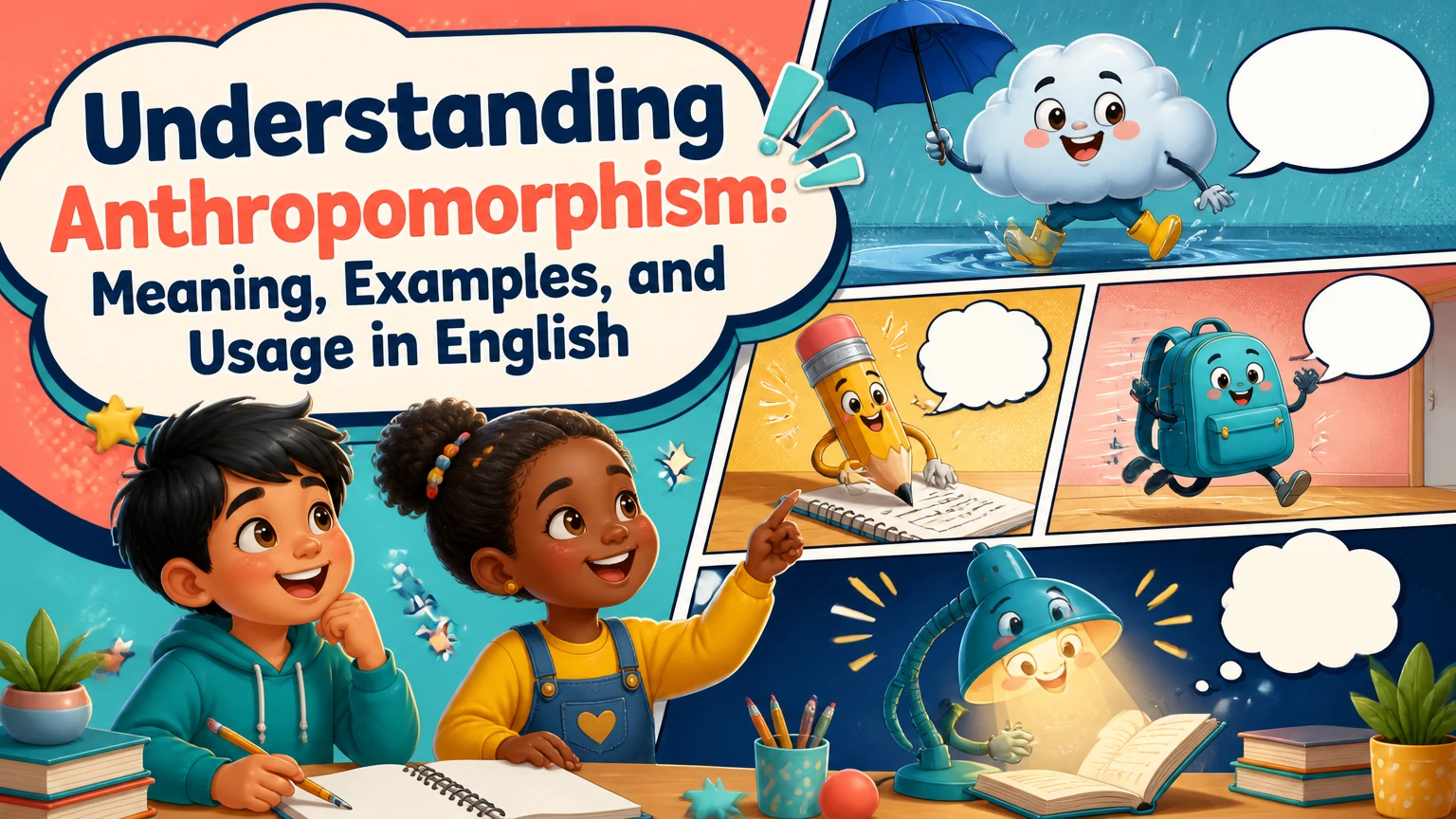
Anthropomorphism is a fascinating linguistic and literary device where human traits, emotions, or intentions are attributed to non-human entities such as animals, inanimate objects, or natural phenomena. This literary technique allows us to relate more deeply to the world around us by describing things through the lens of human experience, including qualities like kindness, stubbornness, wisdom, curiosity, and jealousy. By utilizing these familiar human characteristics, writers and speakers can create more engaging narratives and explain complex concepts in a way that resonates with our own social and emotional understanding. Whether we are discussing a “frowning sky” or a “loyal dog that understands every word,” we are engaging in a process that bridges the gap between the human and non-human worlds. Understanding this concept is essential for students of literature, creative writers, and language learners who wish to master the nuances of figurative language and descriptive prose.
Table of Contents
- 1. Comprehensive Definition of Anthropomorphism
- 2. Etymology and Historical Context
- 3. Structural Breakdown: How Anthropomorphism Works
- 4. Anthropomorphism vs. Personification: The Key Differences
- 5. Types and Categories of Anthropomorphism
- 6. Extensive Examples in Literature and Media
- 7. Usage Rules and Stylistic Guidelines
- 8. Common Mistakes and How to Avoid Them
- 9. Practice Exercises and Assessments
- 10. Advanced Topics: Psychology and Science
- 11. Frequently Asked Questions (FAQ)
- 12. Conclusion
1. Comprehensive Definition of Anthropomorphism
At its core, anthropomorphism is the act of treating non-human things as if they were human. This is not merely a metaphor; it often involves depicting animals or objects as literally possessing human consciousness, speech, and social structures. In a linguistic context, it functions as a way to map human cognitive frameworks onto the behavior of animals or the “behavior” of inanimate forces like the weather or technology.
In literature, anthropomorphism is a foundational element of fables, fairy tales, and modern animation. When a bear wears a hat, carries a briefcase, and worries about his mortgage, he is an anthropomorphic character. This goes beyond simple description and enters the realm of characterization. The non-human entity becomes a “person” in the eyes of the audience, capable of making moral choices and experiencing complex psychological states.
In everyday speech, we use anthropomorphism to make sense of the world. We might say a car “refuses” to start on a cold morning, or that a computer is “trying to annoy” us. While we know the car and computer lack intent, using these human-centric verbs helps us communicate our frustration and perspective. This demonstrates the functional role of the concept in human communication: it provides a shorthand for describing interactions with the environment.
2. Etymology and Historical Context
The term “anthropomorphism” derives from the Greek words anthrōpos, meaning “human,” and morphē, meaning “form” or “shape.” Historically, the term was first used to describe the tendency of ancient civilizations to depict their gods in human form and with human personalities. In Greek mythology, for instance, the gods were not just powerful forces of nature; they were individuals with tempers, romances, and rivalries.
As time progressed, the application of the term expanded from theology to literature and science. In the 18th and 19th centuries, as the study of natural history grew, scientists began to caution against “anthropomorphizing” animals, arguing that attributing human emotions to them could cloud objective observation. However, in the realm of storytelling, the practice flourished, leading to the creation of iconic characters that have become staples of global culture.
Today, anthropomorphism is a multidisciplinary concept. It is studied in psychology to understand how humans develop empathy, in marketing to see how brand mascots influence consumer behavior, and in linguistics to analyze how we use figurative language to structure our reality. It remains one of the most powerful tools in a writer’s arsenal for creating relatable and memorable content.
3. Structural Breakdown: How Anthropomorphism Works
To understand the mechanics of anthropomorphism, we must look at how human traits are mapped onto non-human subjects. This process usually involves three primary layers: physical traits, cognitive traits, and social traits. When these layers are applied, the non-human subject undergoes a transformation in the reader’s mind.
Physical Mapping: This involves giving a non-human entity human physical characteristics. Examples include animals walking upright on two legs, wearing clothing, or using tools with “hands” instead of paws. In animation, this often includes giving animals human-like facial expressions, such as raised eyebrows to indicate surprise or a smirk to show mischief.
Cognitive Mapping: This is the attribution of human thought processes. It includes the ability to speak a human language, solve complex logical puzzles, or experience human emotions like existential dread, nostalgia, or romantic love. When a character like Winnie the Pooh reflects on the nature of friendship, he is exhibiting cognitive anthropomorphism.
Social Mapping: This involves placing the non-human entity within a human social structure. This might include a community of rabbits that has a government, a hierarchy, and a set of laws, or a household of appliances that argue about who is the most useful. By mirroring human society, these stories allow authors to critique or explore human behavior from a safe, metaphorical distance.
4. Anthropomorphism vs. Personification: The Key Differences
One of the most common points of confusion in English grammar and literature is the difference between anthropomorphism and personification. While they are closely related, they serve different purposes and function on different scales. Understanding the distinction is crucial for advanced language mastery.
Personification is a literary device or a figure of speech where human qualities are attributed to something non-human to create a vivid image or metaphor. It is usually temporary and descriptive. For example, saying “The wind howled in the night” is personification. The wind isn’t actually a creature with a voice; the word “howled” is used to describe the sound of the wind.
Anthropomorphism, on the other hand, is the actual transformation of a non-human entity into a human-like character. If the wind becomes a character named “Mr. North Wind” who wears a coat, talks to travelers, and decides to blow softly because he feels kind, that is anthropomorphism. Anthropomorphism is about the character’s essence, while personification is about the imagery used to describe them.
The following table provides a clear comparison to help you distinguish between the two concepts in various contexts.
| Feature | Personification | Anthropomorphism |
|---|---|---|
| Primary Goal | To create vivid imagery or metaphor. | To create a character or literal human behavior. |
| Duration | Often a single sentence or phrase. | Usually sustained throughout a story or scene. |
| Literalism | The object remains an object. | The object/animal acts as a person. |
| Example (Animal) | The cat danced across the floor. | The cat put on his shoes and went to work. |
| Example (Object) | The camera loves her. | The camera complained that its lens was dirty. |
| Complexity | Simple attribution of a verb/adjective. | Complex psychological and social traits. |
5. Types and Categories of Anthropomorphism
Anthropomorphism can be categorized based on the subject being “humanized.” These categories help us understand the breadth of this concept across different fields of study and creative genres.
A. Animal Anthropomorphism
This is the most common form, seen in fables like Aesop’s Fables or modern films like Zootopia. Animals are given human speech, clothing, and social roles. This is often used to teach moral lessons or to satirize human behavior without offending specific groups of people.
B. Object Anthropomorphism
This involves giving human traits to inanimate objects. This is frequent in children’s literature (e.g., The Little Engine That Could) and advertising. It helps consumers form an emotional bond with a product, such as a “friendly” car or a “cheerful” cereal box.
C. Natural Phenomena Anthropomorphism
Humans often attribute intent to the weather or natural disasters. We speak of “Mother Nature” as a sentient being who can be angry or generous. In mythology, the sun and moon are often depicted as siblings with distinct personalities.
D. Abstract Concept Anthropomorphism
Sometimes, abstract ideas like Death, Time, or Justice are anthropomorphized. The “Grim Reaper” is the anthropomorphic representation of death—a skeletal figure that thinks, moves, and performs a specific job. This helps humans visualize and grapple with difficult, intangible concepts.
6. Extensive Examples in Literature and Media
To truly master the concept of anthropomorphism, one must see it in action across various contexts. Below are extensive lists of examples categorized by their application. These examples demonstrate how deeply ingrained this concept is in our culture and language.
The first table focuses on Literary and Media Characters. These are entities that have been fully developed into human-like personas, complete with backstories and motivations. Notice how each character takes a non-human base and adds specific human layers.
| Character Name | Original Form | Human Trait/Action Added |
|---|---|---|
| Mickey Mouse | Mouse | Wears gloves, speaks, has a girlfriend. |
| Winnie the Pooh | Teddy Bear | Composes poetry, feels “stuck” in life. |
| Aslan (Narnia) | Lion | Acts as a moral leader, speaks with authority. |
| The Big Bad Wolf | Wolf | Schemes, wears disguises, speaks. |
| Paddington Bear | Bear | Wears a hat, loves marmalade, travels by train. |
| Bugs Bunny | Rabbit | Outsmarts enemies, uses sarcasm, eats with hands. |
| The Brave Little Toaster | Toaster | Feels loyalty and fear of being replaced. |
| Cogsworth (Beauty & Beast) | Clock | Worrywart, stickler for rules and punctuality. |
| Lumiere (Beauty & Beast) | Candelabra | Flirtatious, hospitable, sings and dances. |
| Simba (The Lion King) | Lion | Experiences guilt, responsibility, and royalty. |
| Peter Rabbit | Rabbit | Wears a blue jacket, disobeys his mother. |
| Donkey (Shrek) | Donkey | Talks incessantly, experiences romantic love. |
| Remy (Ratatouille) | Rat | Has a passion for gourmet cooking and hygiene. |
| SpongeBob SquarePants | Sea Sponge | Works a 9-5 job, has a social life. |
| Brian Griffin (Family Guy) | Dog | Writes novels, drinks martinis, debates politics. |
| The Cheshire Cat | Cat | Speaks in riddles, smiles mischievously. |
| Sonic the Hedgehog | Hedgehog | Has an “attitude,” wears sneakers, runs fast. |
| Kermit the Frog | Frog | Acts as a show producer, plays the banjo. |
| Sherlock Hound | Dog | Solves crimes using deductive reasoning. |
| Thomas the Tank Engine | Train | Feels pride in being a “really useful engine.” |
| Wall-E | Robot | Collects trinkets, feels loneliness and love. |
| The March Hare | Hare | Hosts tea parties, experiences madness. |
| Mr. Fox (Fantastic Mr. Fox) | Fox | Wears corduroy suits, experiences mid-life crisis. |
| Babar the Elephant | Elephant | Rules a kingdom, wears a green suit. |
| The Geico Gecko | Lizard | Talks about insurance with a British accent. |
The next table explores Everyday Expressions and Idioms. These are phrases where we use anthropomorphism to describe the world, even if we don’t literally believe the object is human. These are vital for English learners to understand the figurative side of the language.
| Phrase/Expression | Subject | Human Trait Implied |
|---|---|---|
| My computer is thinking. | Computer | Cognitive processing as “thought.” |
| The engine coughed and died. | Engine | Physical illness and mortality. |
| The sun smiled down on us. | Sun | Happiness and benevolence. |
| The alarm clock yelled at me. | Alarm Clock | Aggression or loud communication. |
| Fortune favors the bold. | Fortune | Preference and favoritism. |
| The walls have ears. | Walls | The ability to listen and spy. |
| My bed is calling my name. | Bed | Desire and verbal summons. |
| The wind whispered secrets. | Wind | Confidential communication. |
| The fire swallowed the house. | Fire | Hunger and consumption. |
| The flowers were thirsty. | Flowers | Physical sensation of thirst. |
| The car groaned up the hill. | Car | Physical strain and vocalizing pain. |
| Opportunity knocks once. | Opportunity | Physical action and intentionality. |
| The sky looks angry today. | Sky | Human emotion (anger). |
| The ocean was in a vengeful mood. | Ocean | Vindictiveness. |
| The trees bowed in the wind. | Trees | Respectful physical gesture. |
| The camera loves her. | Camera | Romantic or aesthetic preference. |
| The shadows danced on the wall. | Shadows | Artistic movement and joy. |
| The cake is calling to me. | Cake | Temptation and verbal persuasion. |
| The house groaned during the storm. | House | Discomfort and vocalizing. |
| Time flies when you’re having fun. | Time | Physical movement (flight). |
| The leaves danced in the breeze. | Leaves | Intentional rhythmic movement. |
| The old radio finally gave up. | Radio | Resignation and loss of will. |
| The storm raged all night. | Storm | Uncontrolled anger and fury. |
| The stars winked at us. | Stars | Playful communication. |
| The traffic was crawling. | Traffic | Physical movement of an insect/baby. |
7. Usage Rules and Stylistic Guidelines
While anthropomorphism is a powerful tool, it must be used with care to ensure clarity and effectiveness. In formal writing, such as academic papers or technical reports, anthropomorphism is generally discouraged because it can lead to imprecision. In creative writing, however, the rules are much more flexible.
Rule 1: Consistency is Key
If you are writing a story where an animal is anthropomorphized, you must maintain that level of humanity consistently. If a dog speaks in Chapter 1, it should not suddenly revert to being a “normal” dog in Chapter 5 without a narrative reason. Inconsistency breaks the “suspension of disbelief” for the reader.
Rule 2: Purposeful Attribution
Don’t anthropomorphize just for the sake of it. Ask yourself: What does this add to the story? Does giving the toaster a personality help illustrate a theme of loneliness, or is it just a random detail? Effective anthropomorphism should serve the narrative or the emotional arc of the piece.
Rule 3: Avoid “The Pathetic Fallacy” in Formal Contexts
The “Pathetic Fallacy” is a specific type of anthropomorphism where human emotions are attributed to nature (e.g., “the cruel sea”). While beautiful in poetry, avoid this in scientific writing. Instead of saying “The bacteria want to survive,” say “The bacteria have biological mechanisms that favor survival.”
| Genre | Acceptability | Primary Purpose |
|---|---|---|
| Children’s Fiction | Very High | Engagement, moral teaching, whimsy. |
| Poetry | High | Evoking emotion and vivid imagery. |
| Journalism | Moderate | Making a story relatable or punchy. |
| Academic Writing | Low | Usually seen as a lack of objectivity. |
| Technical Manuals | Very Low | Precision and literalism are required. |
8. Common Mistakes and How to Avoid Them
One of the most frequent errors is over-anthropomorphizing, which can make a story feel juvenile or confusing. If every single object in a room has a personality, a name, and a backstory, the reader may feel overwhelmed. Balance is necessary to keep the focus on the main characters and plot.
Another mistake is logical inconsistency. For example, if a character is a fish that walks on land but still breathes through gills without any explanation, the internal logic of the world is broken. Even in a fantasy setting, there should be a set of rules that the anthropomorphism follows.
Finally, writers often confuse anthropomorphism with zoomorphism. Zoomorphism is the opposite: giving animal traits to humans (e.g., “He barked orders at his staff”). While both are useful, they serve different metaphorical purposes. Ensure you are using the right direction of attribution for your intended effect.
| Context | Incorrect/Weak Usage | Correct/Strong Usage |
|---|---|---|
| Character Logic | The dog drove the car but couldn’t reach the pedals. | The dog drove the car using special pedal extensions. |
| Clarity | The angry chair tripped the man. | The man tripped over the chair, which seemed to sit there defiantly. |
| Scientific Writing | The cells are trying to find a way to replicate. | The cells replicate through a series of chemical signals. |
| Tone Consistency | The talking cat suddenly barked and chased a squirrel. | The talking cat watched the squirrel with a look of mild disdain. |
9. Practice Exercises and Assessments
To solidify your understanding, complete the following exercises. These are designed to test your ability to identify, create, and refine anthropomorphic language.
Exercise 1: Identifying Anthropomorphism
Read the following sentences and decide if they contain Personification (P) or Anthropomorphism (A).
- The sun peeked over the mountain. (____)
- The rabbit checked his pocket watch and hurried to the meeting. (____)
- The wind sang a mournful song through the trees. (____)
- The teapot complained that the water was too hot. (____)
- The old car wheezed as it climbed the steep driveway. (____)
- The bear wore a tuxedo and played the piano for the guests. (____)
- Justice is blind. (____)
- The computer refused to save my file because it was feeling grumpy. (____)
- The stars danced in the midnight sky. (____)
- The fox explained the rules of the game to the other animals. (____)
Exercise 2: Sentence Transformation
Transform the following literal sentences into anthropomorphic ones by adding human traits, emotions, or actions.
| Literal Sentence | Anthropomorphic Transformation |
|---|---|
| The dog wagged its tail. | The dog smiled and greeted his friend with a happy wag. |
| The wind blew hard. | ______________________________________________________ |
| The clock ticked. | ______________________________________________________ |
| The tree lost its leaves. | ______________________________________________________ |
| The robot moved its arm. | ______________________________________________________ |
| The cat sat on the mat. | ______________________________________________________ |
Exercise 3: Short Story Prompt
Write a 100-word paragraph describing a morning in the life of an anthropomorphic alarm clock. Focus on its thoughts, feelings about its job, and its relationship with its owner. Use at least five specific human traits.
10. Advanced Topics: Psychology and Science
In the world of psychology, anthropomorphism is seen as a natural byproduct of the human “Theory of Mind.” This is our ability to attribute mental states to others. Because our brains are hardwired to look for social cues, we often “over-detect” agency in the world around us. This is why we see faces in clouds (pareidolia) or feel bad for a “lonely” lamp in an IKEA commercial.
In science, the debate over anthropomorphism is ongoing. Ethologists (scientists who study animal behavior) often struggle with how to describe animal emotions. If a chimpanzee appears to grieve for a lost infant, is it “anthropomorphic” to call it grief? Some argue that because humans are animals, many of our “human” traits are actually shared biological traits. This is sometimes called “critical anthropomorphism”—using human experience as a starting point for forming hypotheses about animal behavior while remaining grounded in data.
Furthermore, in the field of Artificial Intelligence (AI), anthropomorphism plays a huge role. We design robots to have faces and voices that sound human because it makes us more comfortable interacting with them. However, this can also lead to “over-trusting” machines, as we mistakenly attribute human ethics and wisdom to a piece of software that is simply following an algorithm.
11. Frequently Asked Questions (FAQ)
Q1: Is anthropomorphism a type of metaphor?
Yes, it can be considered a sustained or literalized metaphor. While a metaphor says something is something else (e.g., “Life is a highway”), anthropomorphism acts as if the non-human thing is a person.
Q2: Can plants be anthropomorphized?
Absolutely. In many stories, trees are depicted as wise old men (like the Ents in The Lord of the Rings) or flowers are shown as gossiping neighbors. Any non-human entity is a candidate for anthropomorphism.
Q3: What is the difference between anthropomorphism and “fable”?
A fable is a genre of story that usually features anthropomorphized animals to teach a lesson. Anthropomorphism is the technique used within that genre.
Q4: Why do we anthropomorphize things when we are angry?
When we are frustrated, our brains look for someone to blame. By attributing intent to a non-living thing (like a “stubborn” door), it gives us a target for our social emotions, making the frustration feel more “logical” to our social brains.
Q5: Is “Mother Nature” an example of anthropomorphism?
Yes. By turning the collective forces of the natural world into a maternal figure with a personality and will, we are using anthropomorphism to make the vastness of nature more comprehensible.
Q6: Does anthropomorphism appear in the Bible or other religious texts?
Yes, many religious texts use anthropomorphism to describe the divine. Phrases like “the hand of God” or describing God as “jealous” or “regretful” are ways of using human concepts to explain the nature of a deity.
Q7: Can anthropomorphism be used in marketing?
Yes, it is extremely common. Think of the M&M characters or the Michelin Man. These characters make brands feel more approachable, friendly, and memorable to consumers.
Q8: Is it ever wrong to use anthropomorphism?
It is “wrong” only in contexts where it leads to dangerous misunderstandings. For example, if a person treats a wild bear like a “cuddly friend” because of anthropomorphic movies, it can lead to physical harm. In writing, it is only “wrong” if it creates confusion or ruins the tone of the piece.
12. Conclusion
Anthropomorphism is a powerful and versatile tool that permeates our language, literature, and daily psychology. By attributing human qualities like bravery, greed, humor, and sadness to the non-human world, we create a bridge of empathy and understanding. Whether you are analyzing a classic fable, writing a modern screenplay, or simply trying to describe why your car won’t start, understanding how to use this device effectively will greatly enhance your communication skills. Remember to use it purposefully, maintain consistency in your characters, and always be aware of the thin line between a simple metaphor and a fully realized anthropomorphic character. With practice, you can use this technique to bring the world around you to life in vivid and meaningful ways.
| Question # | Correct Answer | Reasoning |
|---|---|---|
| 1 | Personification | The sun isn’t literally “peeking” like a person; it’s a metaphor for appearing. |
| 2 | Anthropomorphism | The rabbit uses a human tool (watch) and attends a social meeting. |
| 3 | Personification | The wind doesn’t have vocal cords; “sang” describes the sound. |
| 4 | Anthropomorphism | The teapot is expressing a verbal complaint and feeling sensation. |
| 5 | Personification | “Wheezed” describes the mechanical sound of the engine. |
| 6 | Anthropomorphism | The bear is engaging in complex human social and artistic behavior. |
| 7 | Personification | Justice is an abstract concept given a human physical trait (blindness). |
| 8 | Anthropomorphism | The computer is attributed with a complex human mood (grumpiness). |
| 9 | Personification | The movement of the stars is described as a human action (dancing). |
| 10 | Anthropomorphism | The fox is using human language to explain logical rules. |