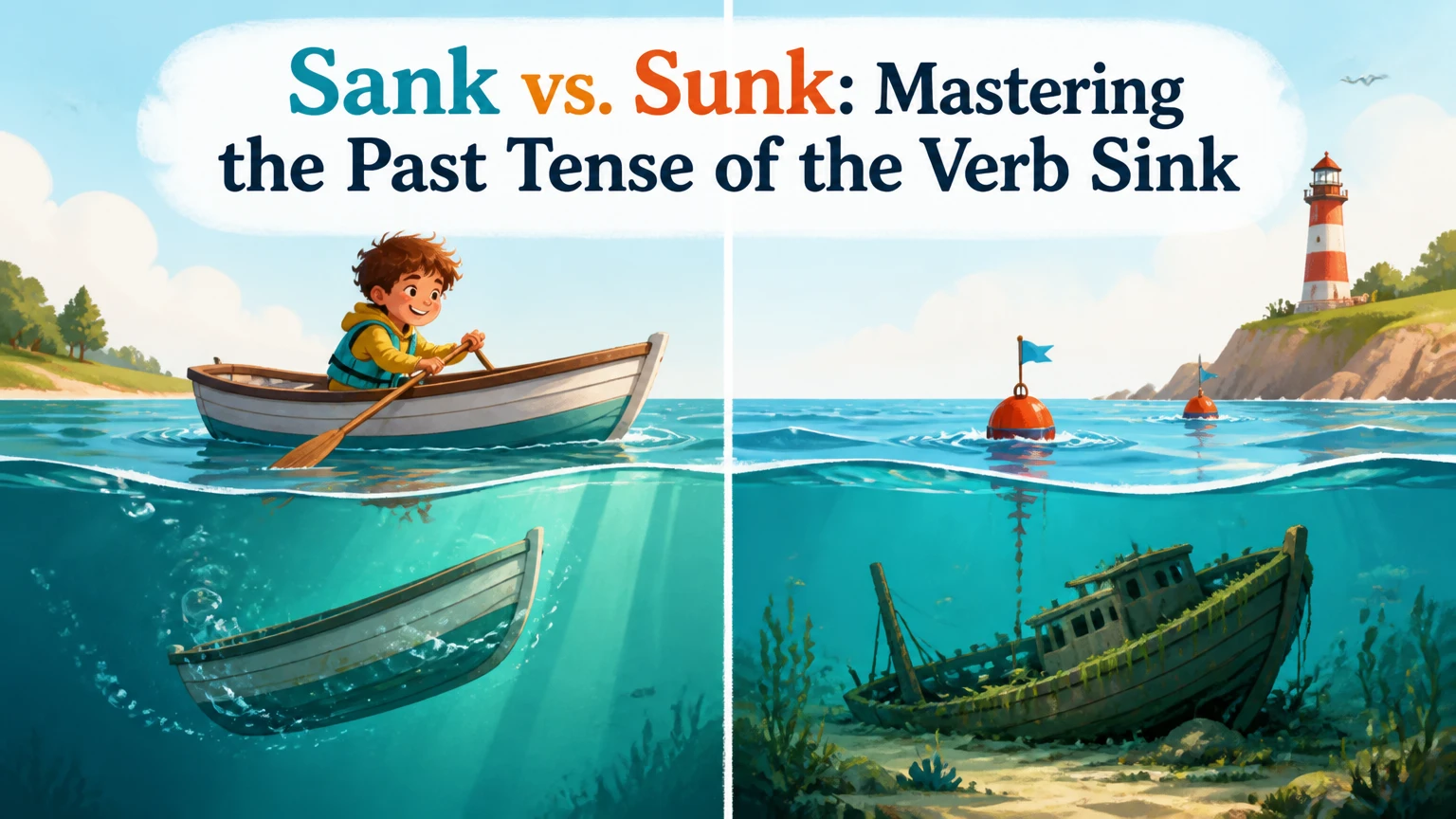
Understanding the distinction between “sank” and “sunk” is a fundamental aspect of mastering English irregular verbs, which often pose challenges for both native and non-native speakers. These two words are different forms of the verb “sink,” representing the simple past tense and the past participle respectively. When discussing things that descend below a surface, we use specific forms such as sank, sunk, sunken, and sinking to indicate the timing and nature of the action. This distinction is vital for maintaining grammatical accuracy in formal writing, academic essays, and professional communication. By learning these nuances, writers can avoid common pitfalls and ensure their prose reflects a high level of linguistic proficiency and clarity.
Table of Contents
- Definition and Linguistic Classification
- Structural Breakdown of the Verb Sink
- Using Sank: The Simple Past Tense
- Using Sunk: The Past Participle
- Sunken: The Adjectival Variation
- Extensive Examples and Comparison Tables
- Comprehensive Usage Rules and Contexts
- Common Mistakes and How to Avoid Them
- Idiomatic Expressions and Phrasal Verbs
- Advanced Topics: Dialectal Variations and History
- Practice Exercises and Worksheets
- Frequently Asked Questions (FAQ)
- Conclusion and Final Learning Tips
Definition and Linguistic Classification
The verb sink is classified as an irregular verb in the English language. Unlike regular verbs that follow a predictable pattern of adding “-ed” to form the past tense (e.g., walk becomes walked), irregular verbs undergo internal vowel changes. This specific pattern is known as an “ablaut” or a vowel gradation, which is a remnant of Old English Germanic roots.
To sink means to fall, settle, or descend below the surface of a liquid or soft substance. It can also refer to a decrease in level, strength, or value. In a figurative sense, it describes a feeling of disappointment or the act of investing resources into a project. Because the word has both physical and metaphorical applications, knowing which tense to use is essential for clarity.
Linguistically, sink belongs to a group of verbs that follow the i-a-u pattern. This group includes other common verbs like sing/sang/sung, drink/drank/drunk, and swim/swam/swum. In this pattern, the “i” in the base form changes to “a” for the simple past and “u” for the past participle. Understanding this pattern helps learners predict the forms of similar verbs.
The distinction between the forms is functional. “Sank” is used for actions that happened and were completed in the past at a specific time. “Sunk” is used with auxiliary verbs (like have, has, or had) to indicate a completed action that has relevance to another point in time or to form the passive voice. Misusing these forms can lead to “non-standard” English, which might be acceptable in casual speech but is usually corrected in formal settings.
Structural Breakdown of the Verb Sink
The verb “sink” consists of four primary forms that every English learner should memorize. These forms dictate how the verb interacts with subjects and auxiliary verbs. Below is the structural breakdown of these forms and their grammatical roles.
The Base Form: Sink
The base form, or infinitive, is used for the present tense (except for the third-person singular) and after modal verbs like can, will, or should. It describes the general action of descending. For example, “Heavy stones sink in water.”
The Simple Past: Sank
The simple past form is used to describe an action that occurred at a specific point in the past. It does not require a helping verb. For example, “The Titanic sank in 1912.” It is a standalone verb that carries the full weight of the action’s timing.
The Past Participle: Sunk
The past participle is used in perfect tenses and the passive voice. It almost always accompanies a helping verb such as have, has, had, is, or was. For example, “The ship has sunk to the bottom.” It can also act as a participial adjective in some contexts, though “sunken” is more common for that role.
The Present Participle: Sinking
The present participle is used for continuous tenses, describing an action that is currently in progress. It is formed by adding “-ing” to the base. For example, “The sun is sinking below the horizon.” It emphasizes the duration or the ongoing nature of the descent.
Using Sank: The Simple Past Tense
The word sank is the correct choice when you are reporting a past event as a simple fact. It is used in the preterite tense. When you use sank, you are usually focusing on the moment the event happened. It is often accompanied by time markers such as yesterday, last year, or at five o’clock.
In narrative writing, sank provides a sense of movement and progression. It tells the reader that the action is finished. For instance, “The basketball sank through the hoop just as the buzzer sounded.” Here, the focus is on the successful completion of the shot in that specific moment.
It is important to remember that sank never takes an auxiliary verb. You would never say “I have sank” or “It was sank.” These are common errors that occur because the “a” and “u” forms are often confused in spoken dialects. In standard written English, sank stands alone to indicate the past.
Beyond physical objects, sank is used for emotions and levels. “My heart sank when I heard the news” is a common idiom expressing sudden sadness. Similarly, “The temperature sank below freezing overnight” describes a change in measurement. In both cases, the action is viewed as a completed historical event.
Using Sunk: The Past Participle
The word sunk serves as the past participle of the verb. Its primary function is to work alongside auxiliary verbs to create complex tenses. The most common use is in the present perfect tense (have sunk) and the past perfect tense (had sunk). These tenses relate the past action to the present or to another past event.
For example, in the sentence “The navy has sunk three enemy vessels,” the focus is on the current state of affairs resulting from past actions. The use of has necessitates the form sunk. If you were to remove the has, you would have to change the verb to sank to remain grammatical.
Sunk is also the form used in the passive voice. The passive voice shifts the focus from the actor to the object being acted upon. For instance, “The old barge was sunk by the authorities to create an artificial reef.” In this construction, was is the helping verb, and sunk is the participle describing the state of the barge.
In some modern contexts, especially in casual speech, sunk is occasionally used as the simple past (e.g., “He sunk the ball”). However, this is considered non-standard. For academic and professional success, it is best to strictly pair sunk with helping verbs and reserve sank for independent use.
Sunken: The Adjectival Variation
While sunk can occasionally function as an adjective (as in “sunk costs”), English has a specialized adjectival form: sunken. This word is used primarily to describe the state or quality of an object that has already gone under or is lower than the surrounding area.
We use sunken when the word precedes the noun it modifies. Common examples include “a sunken ship,” “sunken cheeks,” or a “sunken living room.” In these cases, the word describes a characteristic rather than an action. You would not say “a sank ship” or “a sunk ship” in formal descriptive writing; sunken is the preferred choice.
The distinction between sunk and sunken is largely a matter of position. If the word comes after a linking verb, sunk is often used: “The ship is sunk.” If the word comes before the noun, sunken is used: “The sunken ship is deep.” This subtle rule adds a layer of sophistication to your vocabulary.
Interestingly, sunken is an older form of the past participle that has survived specifically as an adjective. Many irregular verbs used to have “-en” endings for their participles (like drunken or shrunken), but most have been replaced by the shorter “-u” form for verbal use, leaving the “-en” form to serve exclusively as a descriptive word.
Extensive Examples and Comparison Tables
To help visualize the differences between these forms, let’s look at several tables that categorize the usage of sink, sank, and sunk across different contexts and tenses.
Table 1: Conjugation of the Verb Sink
This table illustrates how the verb changes across the most common English tenses, providing a quick reference for learners.
| Tense | Form | Example Sentence |
|---|---|---|
| Present Simple | sink / sinks | Heavy objects usually sink in the ocean. |
| Present Continuous | is/are sinking | The sun is sinking behind the mountains. |
| Simple Past | sank | The stone sank to the bottom of the well. |
| Present Perfect | has/have sunk | The company has sunk millions into research. |
| Past Perfect | had sunk | The boat had sunk before the rescuers arrived. |
| Future Simple | will sink | If you put that in the water, it will sink. |
| Passive Voice | was/were sunk | The vessel was sunk during the storm. |
Table 2: 25 Examples of “Sank” (Simple Past)
The following table provides 25 varied examples of the simple past tense “sank” used in different contexts, from physical actions to metaphorical descriptions.
| # | Context | Sentence Example |
|---|---|---|
| 1 | Maritime | The pirate ship sank after the battle. |
| 2 | Sports | He sank the final putt to win the tournament. |
| 3 | Emotions | Her spirits sank when she saw the test results. |
| 4 | Nature | The sun sank slowly below the horizon. |
| 5 | Weather | The temperature sank to record lows last night. |
| 6 | Objects | The heavy anchor sank rapidly through the water. |
| 7 | Finance | The stock price sank following the news. |
| 8 | Physical Action | She sank into the plush armchair with a sigh. |
| 9 | Geology | The land sank several inches after the earthquake. |
| 10 | Cooking | The cake sank in the middle because the oven was cold. |
| 11 | Metaphor | The truth finally sank in after a few minutes. |
| 12 | Games | I sank his battleship in the third round. |
| 13 | History | The ancient city sank beneath the waves centuries ago. |
| 14 | Posture | He sank to his knees in prayer. |
| 15 | Liquids | The oil stayed on top, but the syrup sank. |
| 16 | Construction | The foundation sank due to the soft soil. |
| 17 | Aviation | The aircraft sank lower into the clouds. |
| 18 | Social | The conversation sank into an awkward silence. |
| 19 | Music | The singer’s voice sank to a low whisper. |
| 20 | Light | The room sank into darkness when the power failed. |
| 21 | Quantity | The water level in the reservoir sank during the drought. |
| 22 | Health | The patient sank into a deep sleep. |
| 23 | Exploration | The probe sank into the soft lunar dust. |
| 24 | Conflict | The negotiations sank into bickering. |
| 25 | Gardening | The fence posts sank further into the mud. |
Table 3: 25 Examples of “Sunk” (Past Participle)
This table demonstrates the use of “sunk” with auxiliary verbs, highlighting its role in perfect tenses and passive constructions.
| # | Auxiliary Verb | Sentence Example |
|---|---|---|
| 1 | Has | The treasure has sunk to the ocean floor. |
| 2 | Have | They have sunk all their savings into the house. |
| 3 | Had | The boat had sunk by the time we got there. |
| 4 | Was | The enemy destroyer was sunk by a torpedo. |
| 5 | Were | Several small crafts were sunk by the hurricane. |
| 6 | Is | The project is sunk if we don’t get funding. |
| 7 | Been | The well has been sunk to a depth of 200 feet. |
| 8 | Could have | The Titanic could have sunk even faster. |
| 9 | Should have | That investment should have sunk months ago. |
| 10 | Might have | The keys might have sunk to the bottom of the lake. |
| 11 | Has | The sun has sunk, and it is now dark. |
| 12 | Have | We have sunk to a new level of disagreement. |
| 13 | Had | She had sunk into depression before seeking help. |
| 14 | Was | The basketball was sunk with perfect precision. |
| 15 | Were | The pilings were sunk deep into the bedrock. |
| 16 | Has | The value of the currency has sunk recently. |
| 17 | Have | They have sunk the shafts for the new mine. |
| 18 | Had | The island had sunk below sea level by 2050. |
| 19 | Is | My heart is sunk by this tragic news. |
| 20 | Are | The costs are sunk and cannot be recovered. |
| 21 | Has | The anchor has sunk into the soft mud. |
| 22 | Have | The roots have sunk deep into the earth. |
| 23 | Had | The level had sunk too low for the pumps to work. |
| 24 | Was | The dream was sunk by a lack of vision. |
| 25 | Has | The foundation has sunk unevenly. |
Comprehensive Usage Rules and Contexts
To use these forms correctly, one must understand the grammatical environment in which they appear. The choice between sank and sunk is not about the meaning of the word “sink,” but rather about the grammatical structure of the sentence. Below are the definitive rules for their application.
Rule 1: The “Helping Verb” Test
The most reliable way to choose the correct form is the helping verb test. If your sentence contains a helping verb (have, has, had, is, am, are, was, were, be, been, being), you should almost always use sunk. If there is no helping verb and you are describing a past action, use sank.
Rule 2: Simple Past vs. Perfect Tenses
Use sank for the simple past. This tense is for actions that are finished and happened at a specific time. Use sunk for perfect tenses, which describe actions that happened at an indefinite time or actions that began in the past and continue to have relevance now. For example: “The ship sank (simple past) in 1942,” versus “The ship has sunk (present perfect) many times in movies.”
Rule 3: Passive Voice Construction
In the passive voice, the object of the action becomes the subject. This construction always requires the past participle. Therefore, you must use sunk. Example: “The golf ball was sunk by the player.” Using “was sank” is a grammatical error because sank cannot function as a participle.
Rule 4: Adjectival Usage
When you need an adjective to describe a noun, use sunken if it comes before the noun (e.g., “sunken treasure”). Use sunk if it follows a linking verb and describes a state (e.g., “The costs are sunk”). Avoid using sank as an adjective entirely, as it is strictly a verb form.
Rule 5: Figurative and Idiomatic Use
The same grammatical rules apply to idioms. If you are using the idiom “to sink in” (meaning to be understood), you would say “The news finally sank in” (past) or “The news has sunk in” (present perfect). Consistency in applying tense rules to idioms is a mark of a fluent speaker.
Common Mistakes and How to Avoid Them
Even seasoned writers occasionally trip over these forms. The most common error is using sunk as a simple past tense without a helping verb. This is often heard in colloquial speech but should be avoided in writing. Let’s examine some frequent mistakes and their corrections.
Mistake 1: The “I Sunk It” Error
Incorrect: “I sunk the boat yesterday.”
Correct: “I sank the boat yesterday.”
Explanation: Since there is no helping verb and a specific time (yesterday) is mentioned, the simple past sank is required.
Mistake 2: The “Has Sank” Error
Incorrect: “The sun has sank.”
Correct: “The sun has sunk.”
Explanation: The presence of the auxiliary verb has requires the past participle form, which is sunk.
Mistake 3: Misusing the Adjective
Incorrect: “They found a sunk ship.”
Correct: “They found a sunken ship.”
Explanation: When the word acts as a direct modifier before a noun, the specialized adjectival form sunken is the standard choice.
Mistake 4: Confusion with Similar Verbs
Learners often confuse sink with sing or drink. While they follow the same pattern (sang/sung, drank/drunk), the contexts are different. Ensure you are not applying the rules of one verb to another where they don’t fit, though the i-a-u vowel shift is a helpful mnemonic.
Table 4: Correct vs. Incorrect Usage
This table summarizes common errors and provides the correct grammatical alternative to help reinforce the rules.
| Incorrect Sentence | Correct Sentence | Reason for Correction |
|---|---|---|
| He sunk the winning shot. | He sank the winning shot. | Simple past requires “sank.” |
| The ship had sank by noon. | The ship had sunk by noon. | Past perfect requires “sunk.” |
| A sunk garden is beautiful. | A sunken garden is beautiful. | Adjective before noun should be “sunken.” |
| My heart has sank today. | My heart has sunk today. | Present perfect requires “sunk.” |
| The anchor was sank. | The anchor was sunk. | Passive voice requires “sunk.” |
Idiomatic Expressions and Phrasal Verbs
The verb “sink” is rich with metaphorical meaning, leading to several common idioms and phrasal verbs. Understanding how to conjugate these expressions is key to natural-sounding English. Here are the most prevalent ones.
Sink in
This phrasal verb means for information or a realization to be fully understood or felt. Example: “It took a while for the gravity of the situation to sink in.” In the past tense: “The reality of his loss finally sank in.”
Sunk cost
This is a term used in economics and business to describe money that has already been spent and cannot be recovered. It is almost always used with the form sunk. Example: “Don’t throw good money after bad; that’s just a sunk cost.”
A sinking feeling
This expression describes a sudden feeling of dread or apprehension. It uses the present participle. Example: “I had a sinking feeling that I had forgotten my passport.”
Sink or swim
This idiom describes a situation where one must either succeed by their own efforts or fail completely. Because it uses the infinitive form, it is usually “sink.” Example: “In the new job, it was sink or swim.” However, in the past: “It was a sink-or-swim situation where many sank.”
Sink to a new low
This means to behave in a way that is particularly immoral or disgraceful. Example: “The tabloid sank to a new low by hacking the victim’s phone.” In the perfect tense: “The political discourse has sunk to a new low.”
Advanced Topics: Dialectal Variations and History
In the study of linguistics, the evolution of “sink” is quite fascinating. Like many irregular verbs, “sink” has faced pressure from “regularization”—the tendency of speakers to make irregular verbs follow regular patterns. While we haven’t reached “sinked” yet, the lines between sank and sunk have blurred in various English dialects.
The “Sunk” as Simple Past Trend
In many American and British dialects, sunk is frequently used as the simple past tense. You will often hear people say, “He sunk the ball” instead of “He sank the ball.” While this is common in speech, it is still rejected by most style guides and academic standards. This phenomenon is known as “leveling,” where the past participle form begins to take over the role of the simple past.
Etymology and Old English
The verb comes from the Old English sincan. In Old English, the vowel changes were even more complex, involving different forms for singular and plural past tense. Over centuries, English simplified these forms into the three we use today. The survival of sunken as a separate adjective is a “fossilized” form of the language’s history.
Transitive vs. Intransitive Use
“Sink” can be both transitive (taking an object) and intransitive (not taking an object). Interestingly, the conjugation remains the same for both. “The ship sank” (intransitive) and “The pirate sank the ship” (transitive) both use the same past tense form. This is not true for all verbs (compare lie/lay), making sink relatively straightforward in this regard.
Practice Exercises and Worksheets
Test your knowledge of sink, sank, and sunk with these exercises. Remember to check for helping verbs before making your choice!
Exercise 1: Fill in the Blank
Choose the correct form (sink, sank, sunk, or sunken) for each sentence.
- The Titanic ________ in the North Atlantic.
- I have ________ all my energy into this project.
- The divers found a ________ treasure chest.
- Every time I try to float, I ________.
- By the time help arrived, the car had ________.
- Yesterday, the temperature ________ below zero.
- He ________ the winning basket at the buzzer.
- The sun is ________ in the west.
- The heavy stone was ________ by the current.
- My heart ________ when I realized I lost my keys.
Exercise 2: Error Correction
Identify and correct the error in each sentence. Some sentences may be correct.
| Sentence | Correction |
|---|---|
| He has sank the boat. | He has sunk the boat. |
| The sun sank an hour ago. | Correct |
| A sunk ship lies below. | A sunken ship lies below. | I sank the putt. |
| The costs had sank. | The costs had sunk. |
| The floor is sinking. | Correct |
| She was sank by debt. | She was sunk by debt. |
| The news sank in slowly. | Correct |
| They have sunken the well. | They have sunk the well. |
| The boat sanked. | The boat sank. |
Exercise 3: Multiple Choice
Select the grammatically correct option.
- Which is correct? (A) I have sank (B) I have sunk
- Which is correct? (A) It sank yesterday (B) It sunk yesterday
- Which is correct? (A) A sunken living room (B) A sank living room
- Which is correct? (A) The sun has sank (B) The sun has sunk
- Which is correct? (A) He sank to his knees (B) He sunk to his knees
Answers to Exercises
| Exercise 1 | Exercise 3 |
|---|---|
| 1. sank | 1. B |
| 2. sunk | 2. A |
| 3. sunken | 3. A |
| 4. sink | 4. B |
| 5. sunk | 5. A |
| 6. sank | |
| 7. sank | |
| 8. sinking | |
| 9. sunk | |
| 10. sank |
Frequently Asked Questions (FAQ)
1. Is “sunk” ever correct as a simple past tense?
In formal, standard English, “sunk” is not correct as a simple past tense. “Sank” is the only accepted simple past form. However, “sunk” is frequently used this way in casual speech or certain dialects. If you are writing for school, business, or publication, always use “sank” for the simple past.
2. When should I use “sunken” instead of “sunk”?
Use “sunken” when you are using the word as an adjective before a noun, such as “sunken treasure” or “sunken eyes.” Use “sunk” when it is part of a verb phrase with a helping verb, such as “The ship has sunk,” or as a predicate adjective after a linking verb, such as “The costs are sunk.”
3. Why do people say “I’ve sunk” instead of “I’ve sank”?
“I’ve sunk” is the correct present perfect form because “sunk” is the past participle. “I’ve” is a contraction of “I have,” and the helping verb “have” must be followed by the past participle. “I’ve sank” is grammatically incorrect.
4. Does “sink” follow the same rules as “drink”?
Yes, they follow the same i-a-u pattern. Drink (present), drank (simple past), drunk (past participle). Just as you would say “I drank the water” and “I have drunk the water,” you say “The boat sank” and “The boat has sunk.”
5. Can “sunk” be an adjective?
Yes, “sunk” can be an adjective, particularly in the phrase “sunk costs.” In this specific context, it refers to money that has been spent and cannot be recovered. For most other descriptive purposes, “sunken” is the preferred adjective.
6. Is “sank” ever used with “have”?
No, “sank” is never used with the auxiliary verb “have.” The combination “have sank” is a common grammatical error. Always use “have sunk.”
7. What is the past tense of “sink” when referring to a kitchen sink?
The noun “sink” (the basin in your kitchen) does not have a past tense because it is an object. However, if you use the verb “to sink” in relation to a kitchen sink—for example, “The plumber sank the new basin into the countertop”—the same rules for the verb apply.
8. How can I remember the difference easily?
A good mnemonic is to remember the alphabet: A comes before U. Therefore, the “A” form (sank) is the first past tense you encounter (simple past), and the “U” form (sunk) is the second one (past participle) used in more complex tenses.
Conclusion and Final Learning Tips
Mastering the difference between sank and sunk is a significant milestone in achieving English fluency. By remembering that sank is the standalone simple past tense and sunk is the past participle used with helping verbs, you can navigate most grammatical situations with ease. Additionally, reserving sunken for adjectival use adds a level of precision to your descriptions. To solidify your understanding, try practicing these forms in your daily writing and pay close attention to how they are used in high-quality literature and journalism. Consistent exposure and deliberate practice are the most effective ways to ensure these rules become second nature. Remember the i-a-u pattern shared by other common verbs, and you will find that irregular verbs are much less daunting than they initially appear.